Commercial ROVs are expensive and closed. I wanted one that anyone with a 3D printer could build, dive, change, and repair. That became TinkerSub, and the first model is the KB-1.
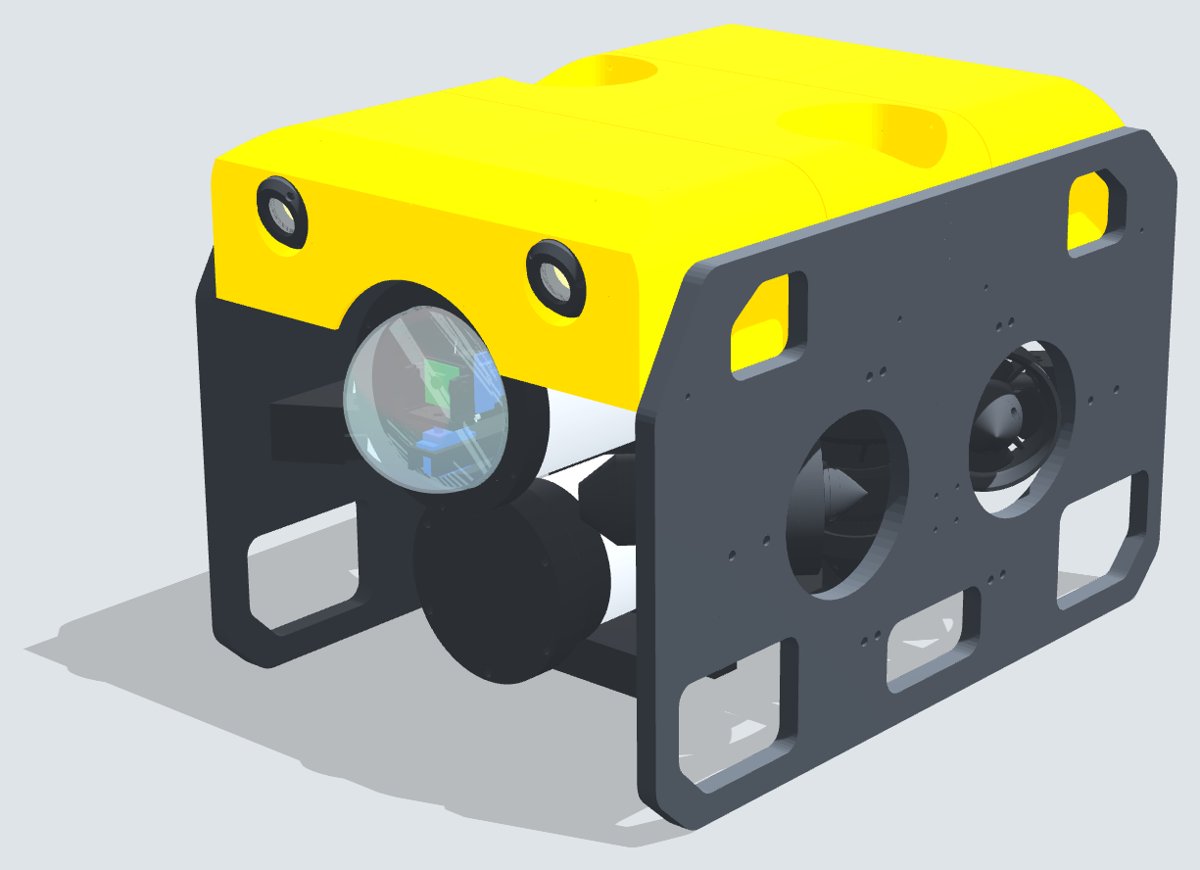
The design goals
- Buildable from a 3D printer, PVC pipe, HDPE sheet, and hardware-store parts.
- Around 20 inches long, with a target depth of 60 feet.
- Roughly $1,100 to $1,300 in parts.
- Fully open: hardware, software, and documentation.
Parts that generate themselves
The decision I'm happiest with is that the printed parts aren't hand-drawn. Python scripts using manifold3d and trimesh generate every STL, 3MF, and STEP file. If you want a bigger hull or a different thruster mount, you change a number and regenerate. It turns the design into something you can adjust rather than a fixed set of files.
What's inside
- Hull: 4-inch and 3-inch PVC with an acrylic dome up front.
- Thrust: 1200 GPH bilge-pump motors driven by IBT_2 motor drivers.
- Brains: a Raspberry Pi Zero 2 W for video and networking, and a Raspberry Pi Pico for thrusters, lights, servos, and failsafes.
- Eyes: an Arducam on a pan-tilt mount, with Cree XHP50.2 lights.
- Power and tether: a 3S 18650 battery pack and a Cat6 tether to the topside program.
Splitting the work between the Pi and the Pico keeps the time-critical control on a microcontroller that doesn't care if the video stream hiccups.
Working with AI as an engineering partner
I designed TinkerSub with Claude. That didn't mean asking for "an ROV" and getting one back. It meant working through decisions together: talking through trade-offs, writing and revising the part generators, and checking parts for printability before burning filament on them. I still made the calls. AI made each iteration faster and caught things I'd have found the expensive way.
The same habit applies to my client work: AI is most useful when someone who understands the problem is steering it.
Where it stands
The design is complete in CAD and the parts have been reviewed for printability. It hasn't been depth-tested yet, so 60 feet is still a target, not a result. That's the next milestone, and this log will cover it.
Everything is on GitHub: hardware under CERN-OHL-S, software under MIT, and docs under CC BY-SA. If you build one, change it. That's the point.